Are you aware of how your customers are finding you?
Not just vaguely aware. Not just a sense that “most people come from Instagram” or “word of mouth is big for us.” Do you actually know the path someone takes from never having heard of you to utilising your service or buying a product?
I’m talking about what search terms they used, how they first heard about your business, whether it was a recommendation from a friend or an ad they scrolled past, what made them curious enough to look you up, and what finally pushed them to convert.
I like to think of this as an invisible thread that connects you and your buyer. It starts the moment they become aware you exist and stretches all the way through to the moment they pay. That thread can be strong and direct, or it can be fragile and easily broken.
The Four Stages of the Customer Journey
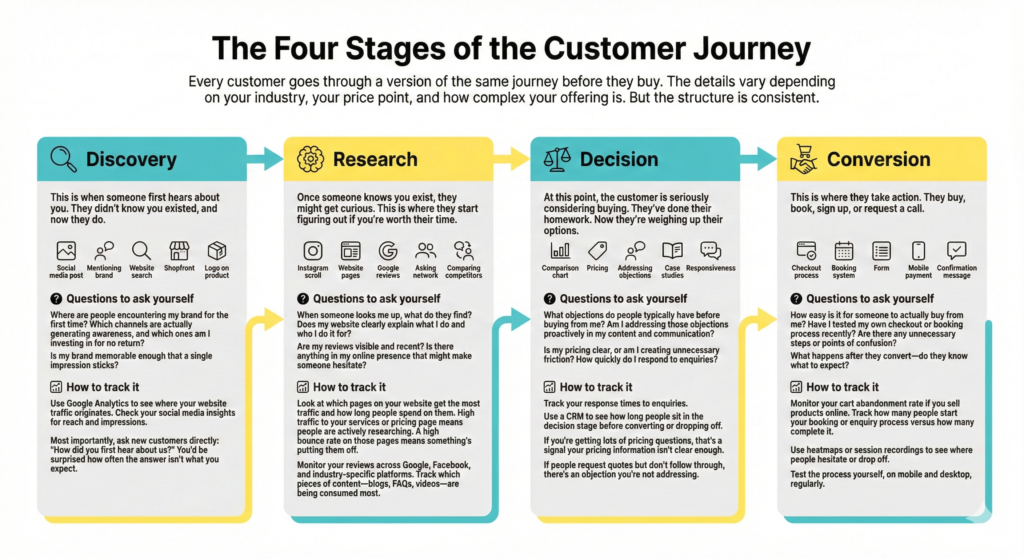
Every customer goes through a version of the same journey before they buy. The details vary depending on your industry, your price point, and how complex your offering is. But the structure is consistent.
Discovery
Discovery can happen in countless ways. Someone might see your post on social media. They might hear your name mentioned by a friend. They could stumble across your website while searching for something related to what you offer.
The important thing to understand is that discovery is often passive. The person wasn’t necessarily looking for you.
This is why brand consistency matters. If someone sees your name three times in three different contexts, a social post, a Google result, a friend’s recommendation, each of those impressions builds on the last.
Questions to ask yourself:
Where are people encountering my brand for the first time? Which channels are actually generating awareness, and which ones am I investing in for no return? Is my brand memorable enough that a single impression sticks?
How to track it:
Use Google Analytics to see where your website traffic originates. Check your social media insights for reach and impressions. Most importantly, ask new customers directly: “How did you first hear about us?” You’d be surprised how often the answer isn’t what you expect.
Research
Once someone knows you exist, they might get curious. This is where they start figuring out if you’re worth their time.
Research looks different depending on the customer and the purchase. For a small, low-risk buy, research might be a quick scroll through your Instagram to see if your work looks legitimate. For a bigger investment, research could involve reading every page of your website, checking your Google reviews, asking around in their network, and comparing you to three competitors.
They’re looking for signals that you’re credible, competent, and trustworthy. They want to understand what you offer and whether it fits their needs. They’re trying to figure out if you’re the kind of business they want to deal with.
Your website does a lot of heavy lifting here. It’s often the first place people go to learn more about you. If it’s unclear, outdated, or hard to navigate, you’re making the research phase harder than it needs to be. If it answers their questions clearly and makes them feel confident in your offering, you’ve strengthened the thread.
Reviews and testimonials also play a major role. People trust other people more than they trust businesses. A collection of genuine, positive reviews can do more to move someone through the research phase than any amount of marketing copy.
Questions to ask yourself:
When someone looks me up, what do they find? Does my website clearly explain what I do and who I do it for? Are my reviews visible and recent? Is there anything in my online presence that might make someone hesitate?
How to track it:
Look at which pages on your website get the most traffic and how long people spend on them. High traffic to your services or pricing page means people are actively researching. A high bounce rate on those pages means something’s putting them off. Monitor your reviews across Google, Facebook, and industry-specific platforms. Track which pieces of content—blogs, FAQs, videos—are being consumed most.
Decision
At this point, the customer is seriously considering buying. They’ve done their homework. Now they’re weighing up their options.
This stage is about comparison. The customer is looking at your offer alongside alternatives, whether that’s your competitors, a DIY solution, or simply doing nothing. They’re evaluating your pricing, your value proposition, and whether you’re the right fit for their specific situation.
The decision stage is where objections live. Price concerns. Trust issues. Uncertainty about whether your solution will actually work for them. If you don’t address these objections, the thread breaks here.
If someone reaches out with a question during the decision stage and you take three days to reply, they’ve probably moved on. Speed signals professionalism and reliability.
Questions to ask yourself:
What objections do people typically have before buying from me? Am I addressing those objections proactively in my content and communication? Is my pricing clear, or am I creating unnecessary friction? How quickly do I respond to enquiries?
How to track it:
Track your response times to enquiries. Use a CRM to see how long people sit in the decision stage before converting or dropping off. If you’re getting lots of pricing questions, that’s a signal your pricing information isn’t clear enough. If people request quotes but don’t follow through, there’s an objection you’re not addressing.
Conversion
This is where they take action. They buy, book, sign up, or request a call.
Conversion might feel like the finish line, but it’s actually the most delicate part of the journey. The customer has decided they want what you’re offering. All that’s left is the transaction itself. And yet, this is where many businesses lose people at the last moment.
A clunky checkout process. A confusing booking system. A form that asks for too much information. A payment gateway that doesn’t work on mobile. An unclear confirmation message that leaves them wondering if it actually went through.
Simplicity is everything here. The fewer steps between “I want this” and “I have this,” the better. Make it obvious what they need to do next. Make the process feel secure and professional. And once they’ve converted, confirm it clearly and tell them what happens next.
Questions to ask yourself:
How easy is it for someone to actually buy from me? Have I tested my own checkout or booking process recently? Are there any unnecessary steps or points of confusion? What happens after they convert—do they know what to expect?
How to track it:
Monitor your cart abandonment rate if you sell products online. Track how many people start your booking or enquiry process versus how many complete it. Use heatmaps or session recordings to see where people hesitate or drop off. Test the process yourself, on mobile and desktop, regularly.
When the Thread Breaks
At any point in this journey, something unclear, something frustrating, or something missing can break the invisible thread. And the worst part is, you often won’t know it happened.
The person who discovered you on Instagram but couldn’t figure out what you actually do. The one who visited your website but found it so cluttered they left within seconds. The potential customer who was ready to buy but couldn’t find your pricing. The one who added something to their cart but gave up when the checkout asked for too much information.
These people don’t send you a message explaining why they didn’t convert. They just disappear. And unless you’re paying attention to your data, you’ll never know they were there at all.
That’s why mapping your invisible threads matters. It’s not enough to assume people are finding you and everything’s working. You need to verify it. You need to understand where people are coming from, where they’re getting stuck, and where you’re losing them.
How to Map Your Invisible Threads
This takes two things: data and conversation.
Data comes from your analytics tools. Google Analytics tells you where your traffic comes from and how people behave on your site. Your social media insights show you what content resonates and what falls flat. Your CRM tracks leads from first contact to closed sale. Your payment platform shows you conversion rates and abandoned transactions.
Look for patterns. Where are most of your customers coming from? Where do they spend the most time? Where do they drop off? The answers are often hiding in plain sight.
Conversation means talking to your customers. Ask them directly: “How did you find us?” Make it part of your process. Include it in your onboarding. Add it to your follow-up emails. You’ll learn things that data alone can’t tell you.
There may be an invisible thread you didn’t know existed. And once you see it, you can strengthen it.
What to Do With What You Learn
Understanding your customer journey isn’t just an intellectual exercise. It should change how you allocate your time and resources.
If most of your customers find you through word of mouth, invest in making your existing customers so happy they can’t help but refer you. If your website is the main research hub, make sure it’s doing its job properly.
Every business has different threads. The point isn’t to copy what works for someone else. It’s to understand your own customer journey and optimise for it.
Stop guessing how customers find you. Start mapping the threads that connect you to them. Understand what’s working, fix what’s broken, and make the path from discovery to conversion as smooth as possible.