Have you ever been super excited to launch a product, post a video, or update your website?
You hit publish. You share it once or twice. And then… crickets.
It’s not a great feeling. You wait around for people to show up, for enquiries to roll in, for something to happen. But the traffic doesn’t come. The inbox stays quiet. And you start wondering if anyone even noticed.
Here’s the uncomfortable truth: traffic doesn’t just happen. You have to drive it.
Building a website isn’t enough. Launching a product isn’t enough. Even doing good work isn’t enough, not if nobody knows about it. The internet is noisy, attention is scarce, and hoping people will find you is not a strategy.
The good news is you don’t need a massive budget or a marketing team to get more eyes on your site. You need consistency, intention, and a few approaches that actually work.
One: Create Content That Answers Your Customers’ Questions
Think about what people are asking before they buy from you. What problems are they trying to solve? What are they typing into Google at midnight when they’re stuck?
Those questions are your content strategy.
Create content around those questions. Blog posts, guides, FAQs, how-to articles. When someone searches for an answer and your website has it, they find you. That’s how you show up on Google without paying for ads.
This is called organic search traffic, and it compounds over time.
Start by listing ten questions your customers ask you regularly. Then write content that answers each one thoroughly. You’re not just creating content for content’s sake. You’re building a library of answers that positions you as the person who knows what they’re talking about.
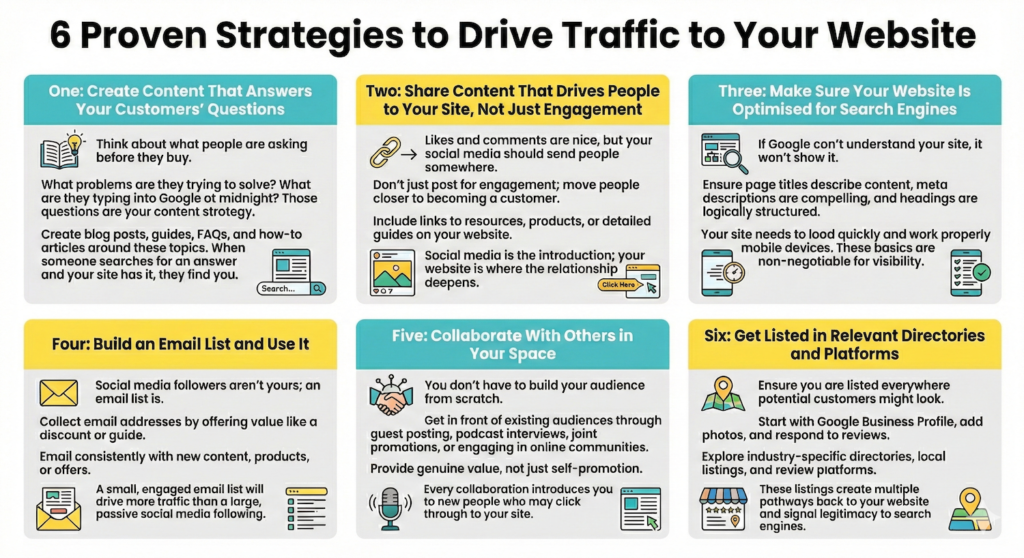
Two: Share Content That Drives People to Your Site, Not Just Engagement
Likes and comments are nice. But if your social media isn’t sending people somewhere, it’s missing a beat.
Too many businesses post content that starts and ends on the platform. It gets engagement, maybe even goes viral, but it doesn’t move anyone closer to becoming a customer. The algorithm is happy. Your business isn’t growing.
Start posting with a purpose. Give people a reason to click through to your website, whether it’s a resource, a new product, a detailed guide, or something valuable they can’t get on social media.
This doesn’t mean every post needs a link. But your overall strategy should be moving people from follower to visitor to customer. Social media is the introduction. Your website is where the relationship deepens.
Try this: for every few posts you share that are purely for engagement or entertainment, include one that offers something more and directs people to your site. A free download. A detailed breakdown. A limited offer. Something that makes the click worth it.
Three: Make Sure Your Website Is Optimised for Search Engines
If Google can’t understand your site, it won’t show it to anyone.
Search engine optimisation sounds technical, but the basics are straightforward. Your page titles should clearly describe what each page is about. Your meta descriptions, the short summaries that appear in search results, should be compelling and accurate.
Beyond that, your site needs to load quickly. If it takes more than a few seconds, people leave and Google notices. It also needs to work properly on mobile. More than half of web traffic comes from phones. If your site is clunky or hard to navigate on a small screen, you’re losing visitors before they even engage.
Run your site through Google’s PageSpeed Insights and see what comes up. Check how it looks on your phone. Make sure every page has a clear title and description. These small fixes can have a big impact.
Four: Build an Email List and Use It
Start collecting email addresses from day one. Offer something valuable in exchange a discount, a free guide, early access to new products, or simply useful content they can’t get elsewhere. Make the signup easy and visible on your website.
Then actually email them. Not constantly, not aggressively, but consistently. Share new content, announce new products, offer exclusive deals. Every email is an opportunity to bring someone back to your site.
Five: Collaborate With Others in Your Space
You don’t have to build your audience from scratch. Other people have already gathered the attention of your potential customers. Find ways to get in front of those audiences.
This could look like guest posting on a relevant blog, being interviewed on a podcast, partnering with a complementary business for a joint promotion, or simply engaging meaningfully in online communities where your customers hang out.
Six: Get Listed in Relevant Directories and Platforms
Sometimes the simplest tactics get overlooked. Are you listed everywhere your potential customers might look for you?
Start with Google Business Profile if you have any local presence at all. Make sure your information is accurate and complete. Add photos, respond to reviews, post updates. This alone can drive significant traffic from local searches.
These listings create multiple pathways back to your website. They also signal to search engines that your business is legitimate and active, which can help your overall visibility.
The businesses that grow are the ones that actively drive attention toward themselves. They create content that answers real questions. They use social media strategically. They optimise for search. They build direct relationships through email. They collaborate. They repurpose. They show up in all the places their customers are looking.
None of this requires a big budget. It requires intention and consistency. Pick one or two of these approaches and commit to them. Do them well before adding more. Traffic builds over time, and so does momentum.
Stop waiting for people to show up. Start giving them a reason to.