You’ve reached the pivotal point in your business where you need to differentiate your personal finances from that of your company’s cashflow. In order to do this, you will need to select a company bank account that offers value, certainty and the right services for your business as it grows.
I think that the bank that you choose and entrust with your business funds should be chosen like you would select a business partner. A bank can unlock a number of different things like
- access to overdrafts when cashflow is tight,
- attractive savings rates through investment products,
- loans when your expanding or making capital investments,
- rental financing when you need premises or
- insurance products to protect your business.
In this way, the bank you choose can become an integral part of your business growth.
Im not saying you have to choose one bank and use them for every additional financial service, you can shop around. But a bank that offers turn key solutions across financing, savings, insurance and banking can be beneficial.
This is why its important to not only look at fees that are the most affordable but to also consider where your business is currently and what you envision over the next 2 to 5 years in terms of growth. Your chosen bank should be able to assist with what you may need access to, like financing or foreign exchange, in order to support your vision.
I believe that as much as your bank works to charge you fees for all sorts of things, you need to ensure that you’re making your bank work for you in terms of what they offer and how your utilizing their products.
Who you chose to bank with can impact your access to funding this is because:
- Banks look at your business account history when you apply for a business loan or overdraft
- A well-managed business account with consistent cash flow improves your chances of being approved for financing
- Some banks offer preferential lending rates or faster approvals to existing business account holders
- Choosing a bank with a focus toward small to medium business lending products can be advantageous as your business grows.
So it’s not a decision you should take lightly.
In my latest Youtube video, I breakdown:
- Different business structures,
- What you’ll need in terms of FICA to open a business account specifically looking at a sole proprietor and private company
- List the specific financial products you can consider for your business
- Compare the business bank accounts on offer through FNB, Absa, Nedbank, Standard Bank and Capitec.
I’ve also created a comprehensive banking guide that covers everything I discuss in the video. You can download it here.

The first thing you would want to have a look at and compare is fee structures. I don’t know why but historically banks have made it hard to understand fee structures. This is changing and becoming more transparent as you can now download pricing on most bank websites. But It’s still important to read the fine print.
The two main fees that are associated with any bank account are the monthly account fee and the transaction fees.
- Monthly account fee – This is the fixed fee charged regardless of your transaction volume. Business bank accounts are generally more expensive than personal accounts so it’s important to take a look at what the monthly fees are, some banks like Nedbank also charge a yearly service fee.
- Transaction fees – This what you pay per payment, transfer or EFT. This is generally a fixed amount per transaction.
It’s important to not only look at the monthly fee on its own, but to also check the transaction fees. A bank with a low monthly fee but high per-transaction costs could end up being more pricey depending on your transaction volumes.
Other fees:
- Cash deposit fee
- Cash withdrawal fee
- Inter-account transfer fee
- Third party payment fee
- Statement fee
- Replacement card fee
This list is not exhaustive, check your bank fees for all applicable fees.
These fees are also important to consider but may be specific to your industry. If you’re a cash heavy business, that needs to deposit cash daily or weekly then cash deposit fees will be important. However if you’re an online business that doesn’t carry too much physical cash then cash deposit fees are less important.
Overview of fees for sole proprietorship accounts (2026 rates):
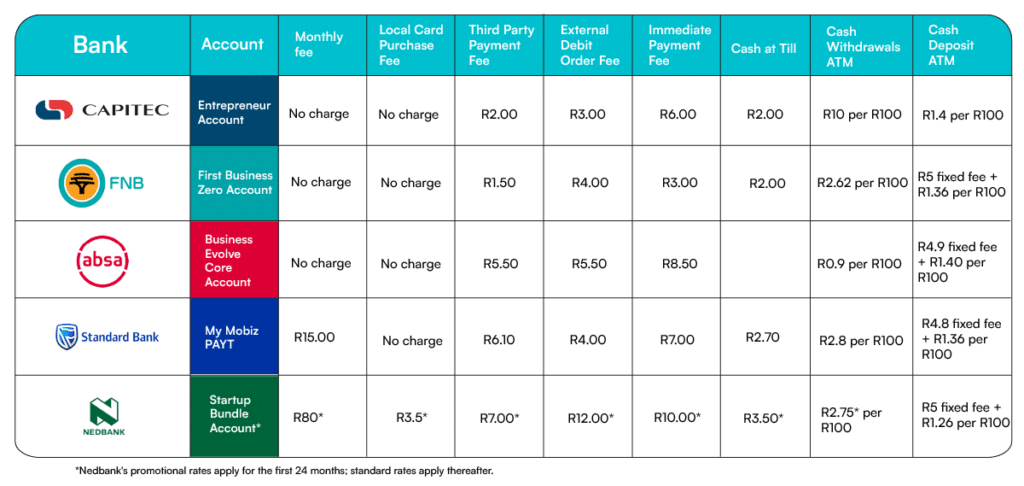
Nedbank’s promotional rates apply for two years and then standard rates apply. Standard rates displayed here. Consult Nedbank’s website for promotional rates.
Overview of fees for private company current accounts (2026 rates):
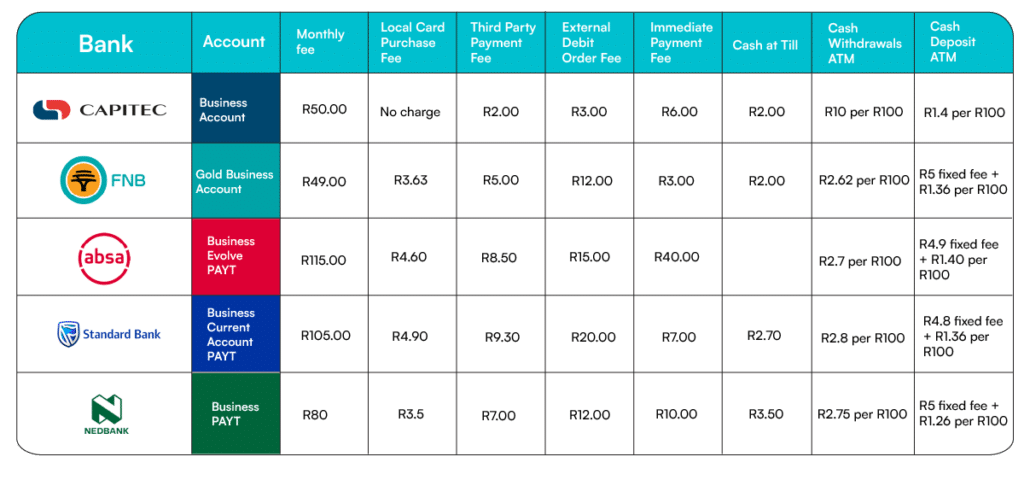
All five banks offer the following products and services. The differentiators are the rates, terms, quality of service, and how easily you can access them.
- Business overdraft facilities
- Credit cards
- Trade finance
- Forex services
- Business insurance
- Savings and investment products
- Vehicle and asset finance
- Point of sale devices
- Business loans