Customers like familiarity. They gravitate toward businesses they recognise, ones that feel reliable and established. This familiarity isn’t just nice to have. It’s an asset. And that asset is called brand equity.
So what exactly is brand equity, and why should you care about it?
Brand Equity, Simply Explained
Brand equity is the value your brand holds in people’s minds. It’s intangible, but it’s real, and it has a direct impact on your bottom line.
It’s why customers choose you over someone cheaper. Why they trust you before they’ve even bought from you. Why they come back without shopping around. Why they recommend you to friends without being asked.
Two businesses can sell the same product at the same price. One struggles to convert leads. The other has customers lining up. The difference, more often than not, is brand equity.
What Builds Brand Equity Over Time
Brand equity doesn’t appear overnight. It’s built through consistent action.
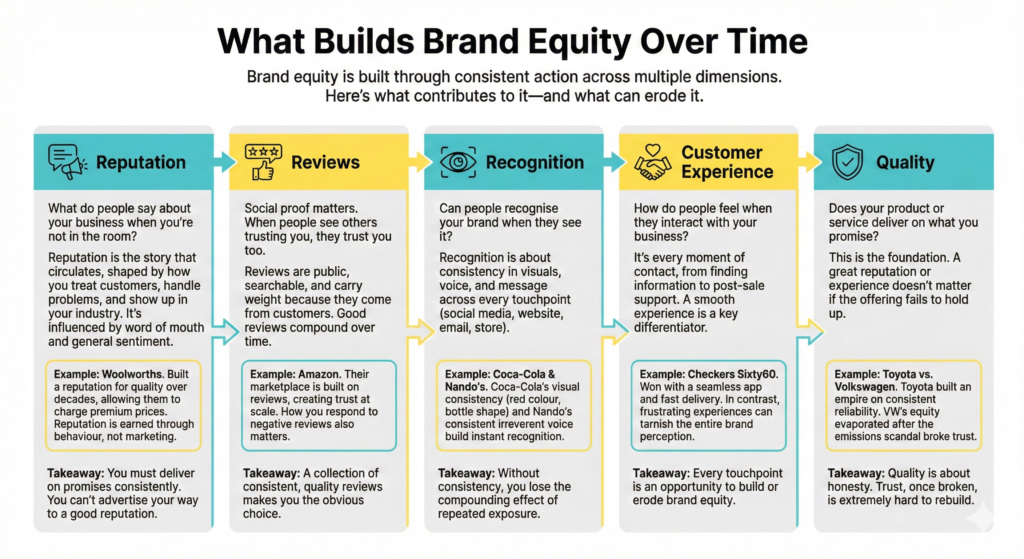
Reputation
What do people say about your business when you’re not in the room?
Reputation is the story that circulates about you. It’s shaped by how you treat customers, how you handle problems, how you show up in your industry.
Reputation is earned through behaviour, not marketing. You can’t advertise your way to a good reputation. You have to deliver on your promises, treat people well, and do it consistently over time.
Reviews
Social proof matters. When people see others trusting you, they trust you too.
Reviews are one of the most visible forms of social proof. They’re public, they’re searchable, and they carry weight precisely because they come from customers rather than from you. A potential buyer reading five glowing reviews is far more likely to convert than one staring at a page with no reviews at all.
Good reviews compound over time. Each one adds to the pile of evidence that you’re worth doing business with. A business that’s evidently consistent, one that delivers quality over and over again, becomes the obvious choice.
Recognition
Can people recognise your brand when they see it?
Recognition is about consistency. It’s your visuals, your voice, and your message aligning across every touchpoint. When someone sees your social media post, visits your website, receives your email, and walks into your store, it should all feel like the same brand.
Coca-Cola is the gold standard here. You can recognise a Coke from across a room, not just by the logo, but by the red colour, the bottle shape, even the font. They’ve been relentlessly consistent for over a century. That consistency means that when you see red and white in a certain configuration, your brain immediately thinks Coca-Cola. That’s recognition so strong it’s almost automatic.
Customer Experience
How do people feel when they interact with your business?
Customer experience is every moment of contact between someone and your brand, from the first time they hear about you to long after they’ve made a purchase. It’s how easy it is to find information on your website. How quickly you respond to enquiries. How smooth the buying process is. How you handle problems when they arise. How you follow up after the sale.
On the flip side, think about a business you’ve stopped using because of a frustrating experience. Maybe the website was confusing. Maybe no one answered your emails. Maybe returning a product felt like pulling teeth. Even if their product was fine, the experience left a bad taste. And that bad taste colours how you perceive the entire brand.
Quality
Does your product or service deliver on what you promise?
This is the foundation everything else rests on. You can have a great reputation, glowing reviews, perfect recognition, and a smooth customer experience, but if your actual offering doesn’t hold up, none of it matters.
Your Website and Brand Equity
Your website is often the first meaningful interaction someone has with your brand. It’s where they go to learn more, evaluate your credibility, and decide whether to take the next step.
A professional, clear, well-built website builds trust. It signals that you take your business seriously. It makes people feel confident that if the website is this good, the product or service probably is too.
Start treating your brand like the asset it is. Protect it. Invest in it. Make decisions that strengthen it rather than ones that trade long-term equity for short-term gains.
The businesses with strong brand equity don’t have to compete on price. They don’t have to fight for every sale. They’ve built something that carries weight, something that makes customers choose them, trust them, and come back without hesitation.
That’s the goal. And it starts with recognising that your brand isn’t just a logo. It’s a promise, repeated and delivered, over and over again.